Across Britain, people are spending more money on vegan products, and plant-based diets are trending online.
With major supermarkets catching on and stocking up on vegan-friendly food – BBC News asks what’s behind the rise?
The number of vegans is on the up
A vegan diet involves cutting out animal products like meat, fish, dairy and eggs.
According to the latest research by , conducted in 2018, there are around 600,000 vegans in Great Britain.
Vegans in Great BritainSource: The Vegan Society, Mintel, Veganuary campaign
It’s estimated that this is up from 150,000 in 2006, and that there are twice as many women than men who are vegan.
Around 360,000 people also describe themselves as lifestyle vegans, who commit to only using or buying cosmetics and clothes free from animal products, for example.
Supermarkets are staying on-trend
Supermarket chains in the UK are stocking more vegan options to keep up with consumers’ food choices.
In 2018 Waitrose introduced a dedicated vegan section in more than 130 shops, while Iceland reported that sales of its plant-based food have risen by 10% over the last year.
And a range of fast-food companies, from Greggs to McDonalds and Burger King to KFC, have launched, or announced, vegan options for the UK.
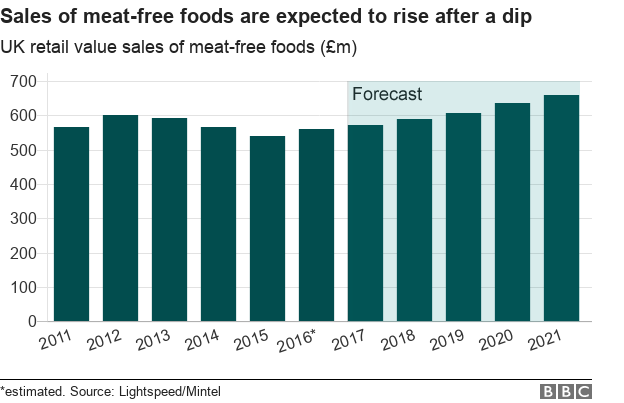
The UK market for meat-free foods was reportedly worth £740m in 2018, according to market researchers , up from £539m only three years ago.
Interest in vegetarian and vegan products shows no sign of slowing down, as retail sales are expected to increase to £658m by 2021.
Do influencers influence what we eat?
Social media has had a big part to play in the rise of the plant-based lifestyle.
Celebrities like Ariana Grande, Miley Cyrus and Ellen DeGeneres are some of the well-known figures who don’t eat animal products, while #vegan has more than 87 million posts listed on Instagram.
Veganism is a hot topic – the number of Google searches worldwide has also spiked in recent years.
The search engine uses a number out of 100 to represent interest in a search term. In 2009, the word “veganism” had a peak popularity score of only 33 but it had increased to 100 only 10 years later.
Google searches for veganism
Popularity for search term “veganism”, recorded on June of each year
Source: Google Trends
The top three most-searched questions on the topic in the UK ask what veganism is, about its sustainability and how it affects climate change.
Giles Quick, director at market researcher Kantar Worldpanel, said: “The vegan market has changed fundamentally in the last six or seven years – it’s now for everyone.
“Social media has brought it to the forefront of customer’s minds, and the mainstream. It’s not seen any more as a choice for life, but as a choice for one meal, one moment, for one or two days a week.”
Flexitarianism, part-time vegetarianism or veganism, is becoming more and more popular. And in January 2019, 250,000 people pledged to go vegan for the first month of the year, under .
More people are signing up to the Veganuary campaign
Source: Veganuary
Launched in the UK in 2014, and supported by a wide range of social media, Veganuary encourages people “to try vegan for January and beyond”.
According to analysts, young women are driving the growth of the vegan movement.
But, a range of reasons lie behind veganism’s rise.
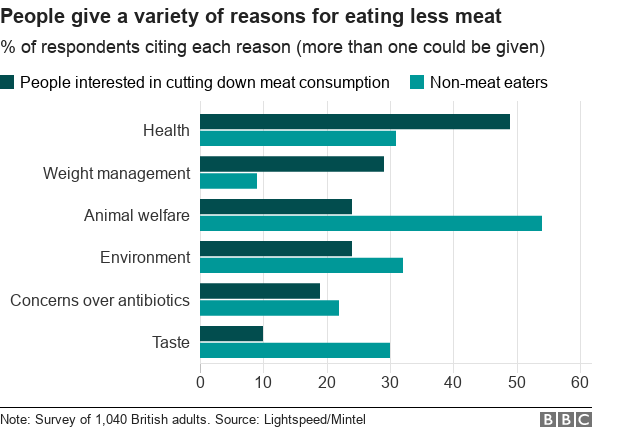
A total of 49% of those interested in cutting down on their meat consumption said they would do so for health reasons, according to a survey of more than 1,000 adults in Great Britain by Mintel.
Weight management, animal welfare and environmental concerns were also big motivators.
With interest increasing all the time in healthy eating, part-time veganism might well become a full-time fixture in many people’s lives.
Update: This piece was originally published on 18 June 2018. It has been updated to reflect the latest available statistics.
The Royal Botanic Gardens, Kew has chosen its top 10 species discovered in 2019, celebrating the diversity of plants and fungi. From a bamboo-dwelling medicinal fungi to a snowdrop spotted on Facebook, this year’s picks represent the breadth of discoveries made by Kew and its collaborators around the world every year
Royal Botanic Gardens, Kew
1. A snowdrop discovered from a holiday photo uploaded to Facebook
A new snowdrop, Galanthus bursanus, from north-west Turkey was discovered on Facebook when a Turkish paediatrician uploaded her holiday photos. They were spotted by a Ukrainian snowdrop specialist who could see from the picture that they were something special
Photograph: D Zubov/RBG Kew
2. Sweet, not sour: A new species of ‘miracle-berry’
Synsepalum chimanimani, a new species of ‘miracle berry’ has been discovered in the lowland rainforests of the Chimanimani Mountains on the Mozambique-Zimbabwe border. The miracle berry is a small tree, just four metres in height, with glossy evergreen leaves produced in small bunches. The twigs produce a white rubbery latex when cut
Photograph: Bart Wursten/RBG Kew
3. Doomed by a hydroelectric dam? New ‘orchid’ discovered in a waterfall
Inversodicraea koukoutamba was discovered on a waterfall on the Bafing River in Guinea, west Africa. It has not been found anywhere else. The new species, identified to be in the family known as the ‘orchids of the falls’ is a rubbery seaweed shrub that grows to 20cm tall. Kew scientists expect it to become extinct when construction on a planned hydroelectric project in the area begins in 2020
Photograph: RBG Kew
4. A bamboo-dwelling medicinal fungus found in China
A medicinal fungus known in China for more than 400 years has been fouond to be a genus as well as a species previously unknown to science. It has now been formally named Rubroshiraia bambusae. The new genus is native to Yunnan in south-west China where it grows on a species of bamboo, forming pink ball-like fruiting bodies. The fungus is used as traditional medicine in the area to treat arthritis and infantile convulsions. However, scientific interest has increased because of the discovery of compounds in the fungus known as hypocrellins
Photograph: Cici Dong-Qin Dai/RBG Kew
5. Ten new species of bears’ breeches found in tropical Africa
Ten new bears’ breeches were found this year in tropical Africa by Kew scientists. Particularly noteworthy are two blue-flowered flower species of Baleria found in Angola: Barleria deserticola and Barleria namba. B deserticola, from the Namib coastal desert, was first collected 160 years ago by the explorer Friedrich Welwitsch, but was only re-found in 2017, finally allowing this species to be named this year by Kew. B. namba only came to light very recently, having been discovered on the previously unexplored Mount Namba
Photograph: Erin Tripp/RBG Kew
6. A bright pink, candy cane-striped violet from New Guinea
A spectacular new species from the African violet family, Cyrtandra vittata, was discovered this year in northern New Guinea. The striking, bright pink candy cane-striped flower grows on a shrub in the rainforest and its white berries are thought to be dispersed by doves and pigeons. The African violet was collected from the wild under permit. Once propagated from cuttings it was discovered to be a new species when it flowered in cultivation
Photograph: Lynsey Wilson/RBG Kew
7. Eleven new trees and shrubs found in the Andean forests
Eleven new species of trees and shrubs have been discovered in the Andean forests in South America this year. All 11 are in the plant genusFreziera. These new trees could have many uses. Some of the genus are known to produce compounds that could be of medicinal or biochemical value. Other species have also been proposed as conservatory plants because of their attractive glossy, variously sculptured leaves
Photograph: JG Graham/RBG Kew
8. Endangered by a volcano
Costularia cadetii, a perennial herb, grows on the rims of the volcanoes in Réunion, an island in the Indian Ocean east of Madagascar. The first record of it was collected in 1965 but further material was needed and it was only officially named this year. The herb was named after its collector, Thérésian Cadet, a former teacher and climbing enthusiast. The species is classified as endangered as it is restricted to this high-elevation habitat, which puts it at risk from volcanic activity, fire and climate change
Photograph: J Bruhl/RBG Kew
9. A botanists’ love letter: Kew scientist named orange flower after his wife
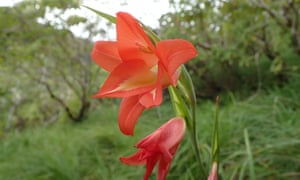
Found growing on a table-stone mountain in Kounounkan in Guinea is the Gladiolus mariae.The Kew scientist Xander van der Burgt found the vivid orange flower to be restricted to two mountains in the area – the mountains are among the last to remain unaffected by humans. It likes to grow in fire-free habitats and occurs in open vegetation with little grass. Xander decided to name the flower after his wife, Maria
Photograph: Xander van der Burgt/RBG Kew
10.A rare find: the zonozono tree
With just seven trees known on the planet, zonozono, a 20-metre tree in the ylang ylang family, is perhaps the rarest species discovered this year. It has been identified in a genus previously known only in west Africa and not suspected to be present in the Usambara Mountains of Tanzania in the east of the continent. It is assessed as endangered because of the low number of individuals and threats from pole-cutting and an invasive tree species